The Ultimate German Learning Roadmap (A1 to B2): The Complete Step-by-Step Guide for Beginners
DipLangs Team
12 August 2026
Introduction
When I first moved to Germany to pursue my master's degree, I thought learning German would be straightforward.
I downloaded a few language apps, watched YouTube videos, bought grammar books, and promised myself that studying for 20 minutes every day would be enough.
It wasn't.
Every resource focused on something different.
One app only taught vocabulary.
Another focused on grammar drills.
Some websites told me to ignore grammar and just start speaking.
Others insisted grammar should come first.
After a few months, I realized I wasn't actually learning German.
I was collecting resources.
Every day I switched between different apps, websites, books, and videos, but none of them explained what I should learn next. That was the biggest problem. There was no roadmap.
Looking back, I don't think German was as difficult as I believed.
The real challenge was trying to learn without a clear direction.
Eventually, I created my own learning plan.
It helped me stay focused, made my progress measurable, and later became the foundation for building DipLangs.
This article is the roadmap I wish someone had given me on my very first day in Germany.
Whether you're learning German for work, university, travel, or simply because you enjoy the language, I hope it saves you the months of confusion that I went through.
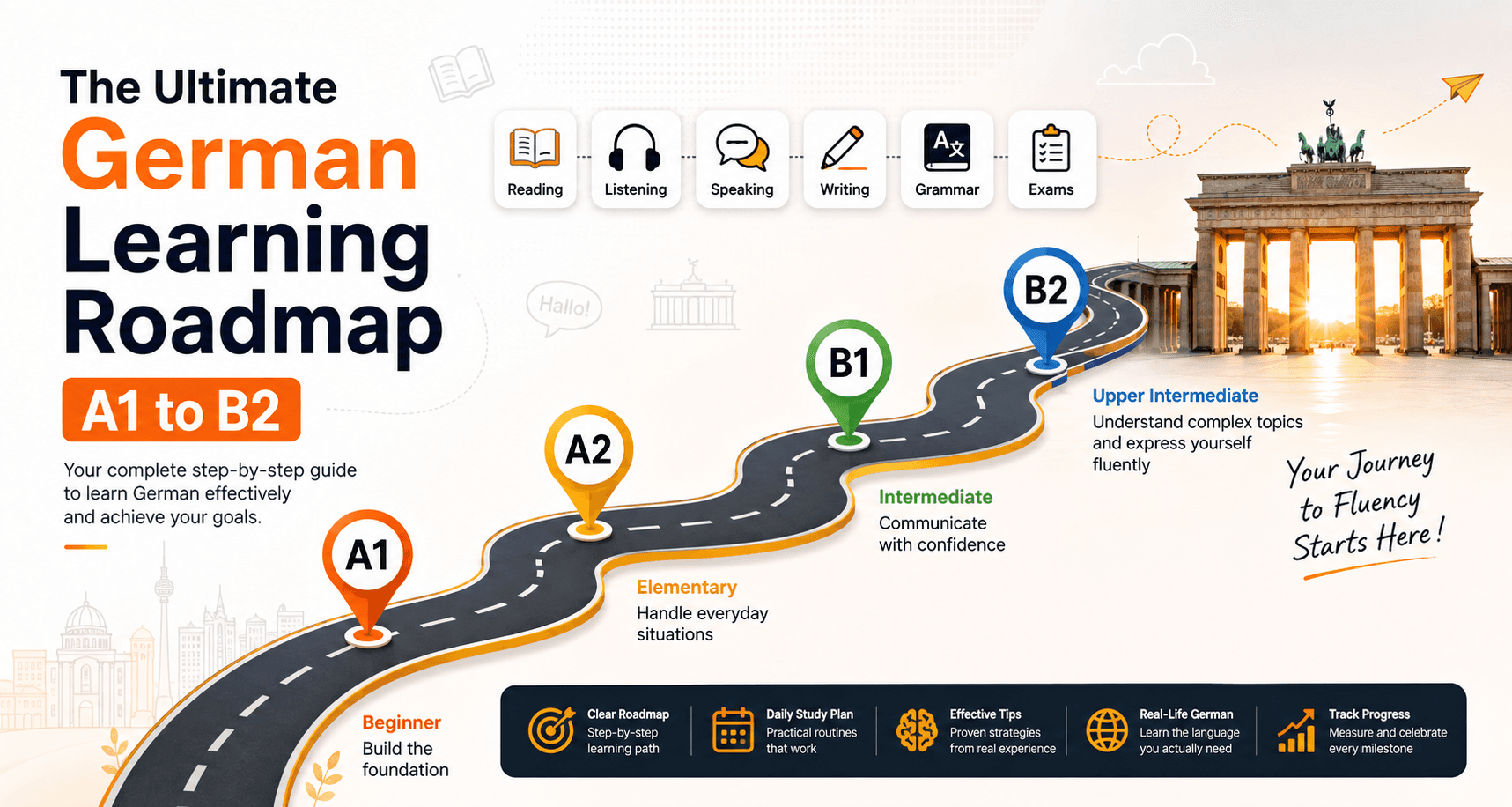
Before You Start: Understand the CEFR Levels
German proficiency is divided into six internationally recognized levels.
A1 – Beginner
Introduce yourself confidently.
Understand basic everyday conversations.
Use simple sentences about daily life.
A2 – Elementary
Handle shopping, appointments, travel, and routine conversations.
Understand commonly used expressions.
Talk about familiar topics.
B1 – Intermediate
Communicate independently in most everyday situations.
Write emails and longer texts.
Understand the main points of TV shows and articles.
B2 – Upper Intermediate
Discuss complex topics confidently.
Work or study in German.
Understand newspapers, podcasts, and professional conversations.
Phase 1 – A1: Build the Right Foundation
The biggest mistake I made was trying to learn too many words too quickly.
Instead of understanding how German sentences worked, I kept memorizing vocabulary lists.
A week later, I had forgotten most of them.
If I had to start again, I would spend my first few months building a strong foundation.
Grammar
At A1, focus on:
Articles (der, die, das)
Personal pronouns
Present tense verbs
Question words
Sentence structure
Negation
Modal verbs
Numbers
Time expressions
Everyday prepositions
Don't worry about advanced grammar.
Understanding these topics well is enough.
Vocabulary
Aim for around 800–1,000 words.
More importantly, learn words in context.
Instead of memorizing
Haus = House
learn
Ich gehe nach Hause.
or
Das Haus ist groß.
Your brain remembers complete ideas much better than isolated words.
Reading
Start reading immediately.
Many learners wait until they know "enough vocabulary."
Don't.
Simple stories expose you to grammar naturally and help reinforce vocabulary without memorization.
Even if you understand only half of the story, you're still making progress.
Listening
Spend at least 10–15 minutes every day listening to German.
Don't worry if you don't understand everything.
Listening trains your brain to recognize pronunciation and sentence rhythm long before you become fluent.
Speaking
This is where I made another mistake.
I waited too long.
I wanted perfect grammar before speaking.
That day never came.
Start speaking from Day 1.
Even if it's only introducing yourself or describing your room.
Confidence grows through practice not perfection.
Phase 2 – A2: The Stage Where Most Learners Quit
A2 is where German suddenly feels harder.
Grammar becomes more complex.
Sentence structures become longer.
Vocabulary grows quickly.
Many learners think they've stopped improving.
In reality, they're entering the stage where real progress begins.
Keep going.
Focus on learning
Perfekt tense
Dative case
Reflexive verbs
Comparative adjectives
Subordinate clauses
Everyday conversations
Vocabulary Goal
Approximately 1,500–2,000 words.
Again, quality matters more than quantity.
Reading
Move beyond beginner texts.
Read children's books.
Short news articles.
Simple blog posts.
Anything that keeps you interested.
Listening
Listen to slow German news.
Watch German YouTube channels.
Replay difficult sections instead of translating every sentence.
Phase 3 – B1: Becoming Independent
Reaching B1 feels different.
For the first time, you realize you can actually live in German.
You won't understand everything.
But you'll understand enough.
Enough to travel.
Enough to study.
Enough to work.
Enough to build confidence.
Grammar
Now learn:
Passive voice
Relative clauses
Konjunktiv II
Advanced word order
Future tense
Vocabulary Goal
Around 2,500–3,000 words.
Reading
This is the perfect time to read longer stories.
Don't be afraid of unknown words.
Guess meaning from context before opening a dictionary.
Writing
Practice:
Opinion essays
Formal emails
Complaint letters
Goethe exam tasks
Writing is one of the fastest ways to improve grammar because it forces you to actively construct sentences.
Phase 4 – B2: Think in German
Most people imagine B2 means knowing every German word.
It doesn't.
It means expressing yourself naturally.
At B2, your focus should shift from learning rules to using the language.
Watch movies.
Listen to podcasts.
Read books.
Have conversations.
Write regularly.
The more German becomes part of your daily life, the more natural it feels.
The Daily Study Routine That Worked Best for Me
One question I get asked often is:
"How long should I study every day?"
My answer is always the same.
Study consistently.
Not perfectly.
If you only have 30 minutes
10 minutes reading
10 minutes listening
10 minutes vocabulary
If you have one hour
15 minutes grammar
15 minutes reading
15 minutes listening
15 minutes speaking
If you have two hours
Grammar
Reading
Listening
Vocabulary
Speaking
Writing
Try to touch every language skill during the week instead of studying only grammar or only vocabulary.
The Biggest Mistakes I Made
Looking back, these slowed my progress more than anything else.
1. Memorizing vocabulary without context
Stories work much better.
2. Waiting until I felt "ready" to speak
You never feel ready.
Start anyway.
3. Ignoring listening practice
Understanding spoken German takes much longer than reading.
Start early.
4. Jumping between too many resources
This was probably my biggest mistake.
I had five apps.
Three YouTube channels.
Two grammar books.
None of them connected together.
Consistency beats variety.
5. Studying only when I felt motivated
Motivation disappears.
Habits remain.
Even twenty minutes every day is enough to make noticeable progress over time.
Why I Eventually Built DipLangs
After spending months switching between different apps, I realized every platform solved only one part of language learning.
One focused on vocabulary.
Another focused on grammar.
Another focused on exam preparation.
I wanted everything connected in one learning journey.
That's why I built DipLangs.
Instead of jumping between multiple platforms, learners can practice reading, listening, grammar, writing, speaking, and AI-powered feedback in one place.
It's the learning experience I wish I had when I started.
Final Thoughts
If you're just beginning your German journey, don't compare yourself to someone who has been learning for years.
Every fluent speaker once struggled with der, die, and das.
Every confident conversation started with simple words and awkward sentences.
Progress isn't about studying for ten hours one day.
It's about showing up consistently, even when you only have twenty minutes.
German is a marathon, not a sprint.
Some days you'll feel like you're making incredible progress.
Other days you'll feel stuck.
Keep going.
One story.
One lesson.
One conversation.
One day at a time.
Frequently Asked Questions
1. How long does it take to learn German from A1 to B2?
For most learners studying consistently, reaching B2 typically takes 12–24 months, depending on your study time, prior language experience, and opportunities to practice.
2. Can I learn German without living in Germany?
Yes. Living in Germany can provide more opportunities to practice, but many learners reach B2 through structured self-study, online conversations, and consistent exposure to German media.
3. Should I learn grammar first or vocabulary first?
Both should develop together. Grammar helps you understand how sentences work, while vocabulary gives you the words to express yourself. Learning vocabulary in context—through stories, conversations, or example sentences—is usually more effective than memorizing isolated word lists.
4. Is Duolingo enough to become fluent?
Apps can be a helpful starting point, but fluency requires reading, listening, speaking, writing, and real-world practice. Using a combination of resources provides a more complete learning experience.
5. What's the biggest mistake beginners make?
Trying to use too many resources at once. Following a clear roadmap and studying consistently is usually more effective than constantly switching between apps, books, and videos.
Ready to practise?
Explore grammar lessons, reading chapters, and speaking practice on DipLangs.
Start Learning Free